


Contact
Prof. Dr. Annika Johansson
phone: 0345 55 25455
annika.johansson@physik.uni...
room E.13.0
Karl-Freiherr-von-Fritsch-Str. 3
06120 Halle (Saale)
(momentan in Elternzeit)

Research
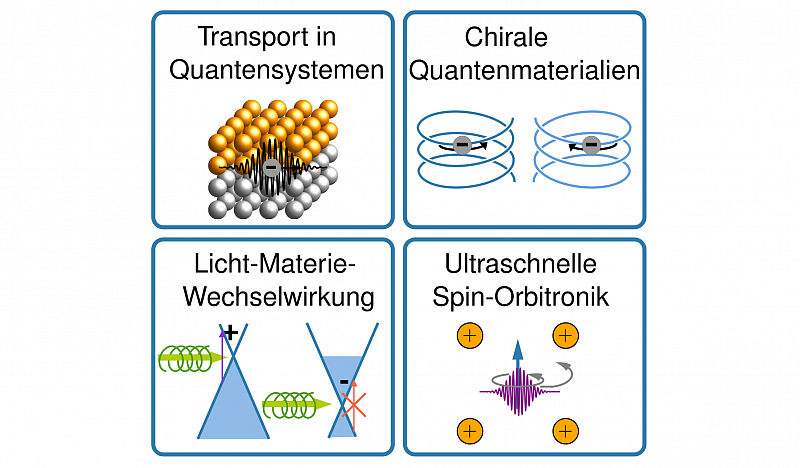
Research topics of the group Mesoscopic Quantum Dynamics
Transport in Quantum Systems
We study transport phenomena in solids that originate from quantum effects, e.g., anomalous charge transport, spin currents, and orbital transport. To this end, we use semiclassical Boltzmann transport theory, the Kubo formalism, density-matrix methods, and Green's functions. To describe solid-state systems, we primarily employ effective models and tight-binding methods.
In particular, we focus on transport phenomena within the field of spintronics: The goal is to use the electron's spin, an intrinsic form of angular momentum and source of magnetism, as an information carrier, in order to realize fast, energy-efficient, and non-volatile devices for data storage and processing. We theoretically investigate how electron spin can be controlled and transported, and how properties of quantum materials can be tuned by magnetic and electric fields.
In addition to spin, the orbital angular momentum can also contribute to magnetic properties. The field of orbitronics explores whether and how orbital magnetic moments can be generated, transported, and exploited.
Topical Review on charge-spin conversion
Chiral Quantum Materials
A system is chiral if its mirror image cannot be superimposed on the original structure by any combination of rotations and translations. Chirality is ubiquitous in nature and technology, for example in chiral molecules and screws.
Solids can also be chiral. Structural chirality is closely intertwined with a material's spin and orbital degrees of freedom. We investigate how structural chirality, topology, electronic, magnetic, optical, and transport properties are interrelated. Our goal is to predict and understand chirality-induced phenomena, such as transport of spin and chiral charge. This research contributes to the Cluster of Excellence "Center for Chiral Electronics" .
Light-Matter-Interaction
In topologically nontrivial materials, light can induce unconventional transport phenomena, such as quantized photocurrents. We calculate these light-induced responses and investigate how they can be controlled by polarization, pulse shape, and structure of light.
Ultrafast Spin-Orbitronics
Many spintronic phenomena rely on the concept of spin-orbit coupling, which is konwn as spin-orbitronics. In recent years, the field of orbitronics has emerged, exploiting also the electron's orbital degree of freedom. Whereas spintronic technologies often rely on heavy, rare, or toxic materials, in orbitronics, also light, better available materials can be exploited.
We investigate how dynamical orbital and spin transport effecs can be controlled and harnessed on ultrafast time scales. This research focus is related to the CRC/TRR 227 "Ultrafast Spin Dynamics"